🤫
This work is password protected.
Incorrect password.
Etsy · 2023–2024 · Case Study
Sellers are the heartbeat of the Etsy marketplace, powering 90 million buyers and creating the items that differentiate Etsy from the competition. But after years of growth, we'd lost the unified narrative that aligned seller-facing teams around a common goal. This is the story of how we built it back.
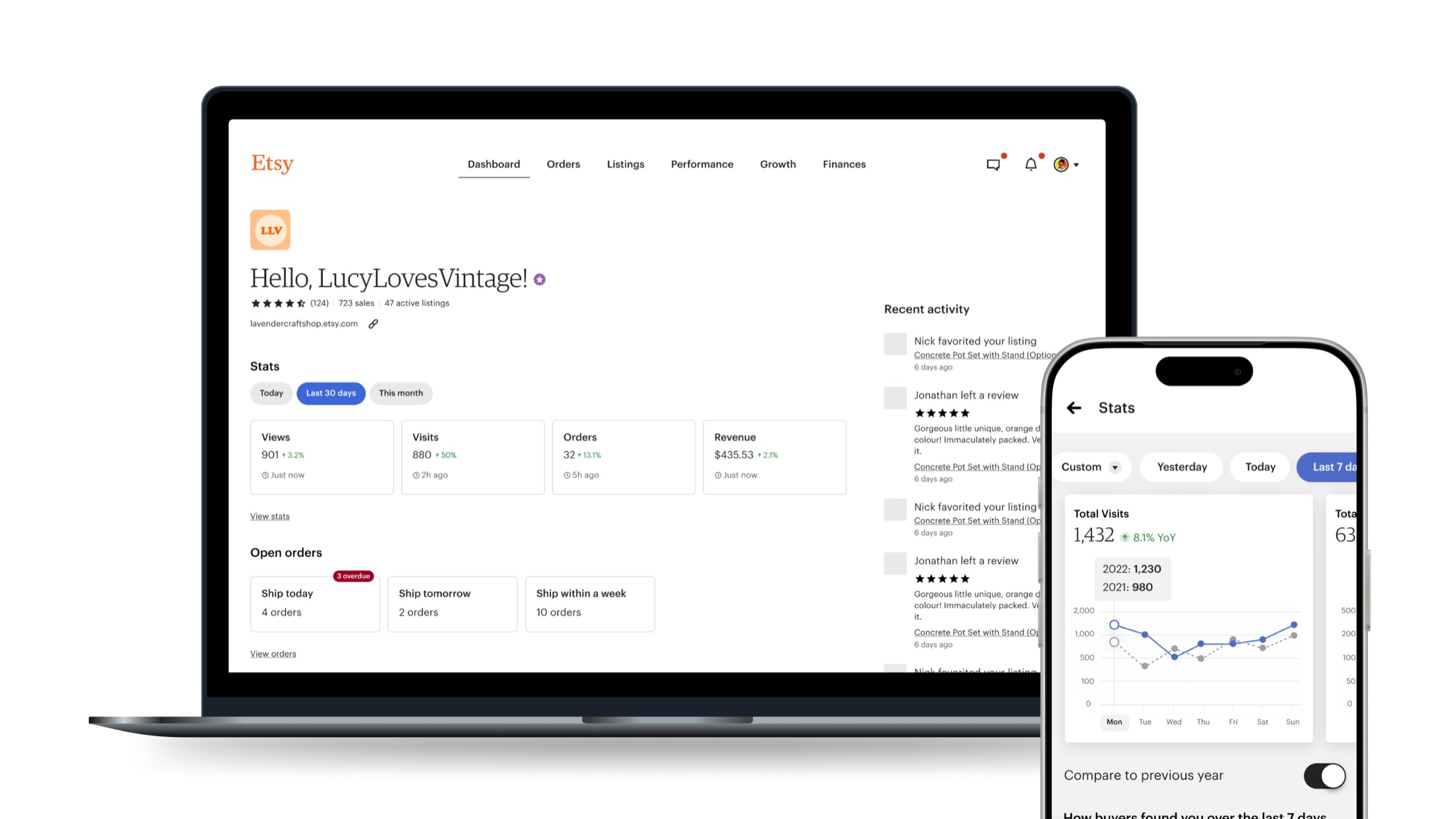
Fig 1: Redesigned web and native seller applications utilizing the new Etsy Seller Vision
Context
At Etsy, I co-led the Seller Experience Group with my Product and Engineering partners, a group of 8 squads building across both Shop Manager (responsive web) and the Etsy Seller App (native). Beyond our group, there were 14 seller-facing squads total operating across the organization.
Each squad was doing meaningful work. But they were doing it in silos. The seller experience had grown without a unifying narrative, and it showed: in the product, in the planning process, and in the numbers.
At the same time, Etsy had set an aggressive revenue target: $3.5B from seller revenue by 2027, up from $2.6B in 2023. Continuing to operate as we were (fragmented, unaligned, reactive) would not get us there.
90M
Active buyers on the platform
14
Seller-facing squads, operating in silos
$3.5B
Seller revenue goal by 2027
There was also something more immediate: Shop Manager, the primary web tool for Etsy sellers, hadn't seen a major redesign since 2016. The platform usability score had dropped from ~78% to 60% in two years. Sellers were frustrated, and they were telling us about it.
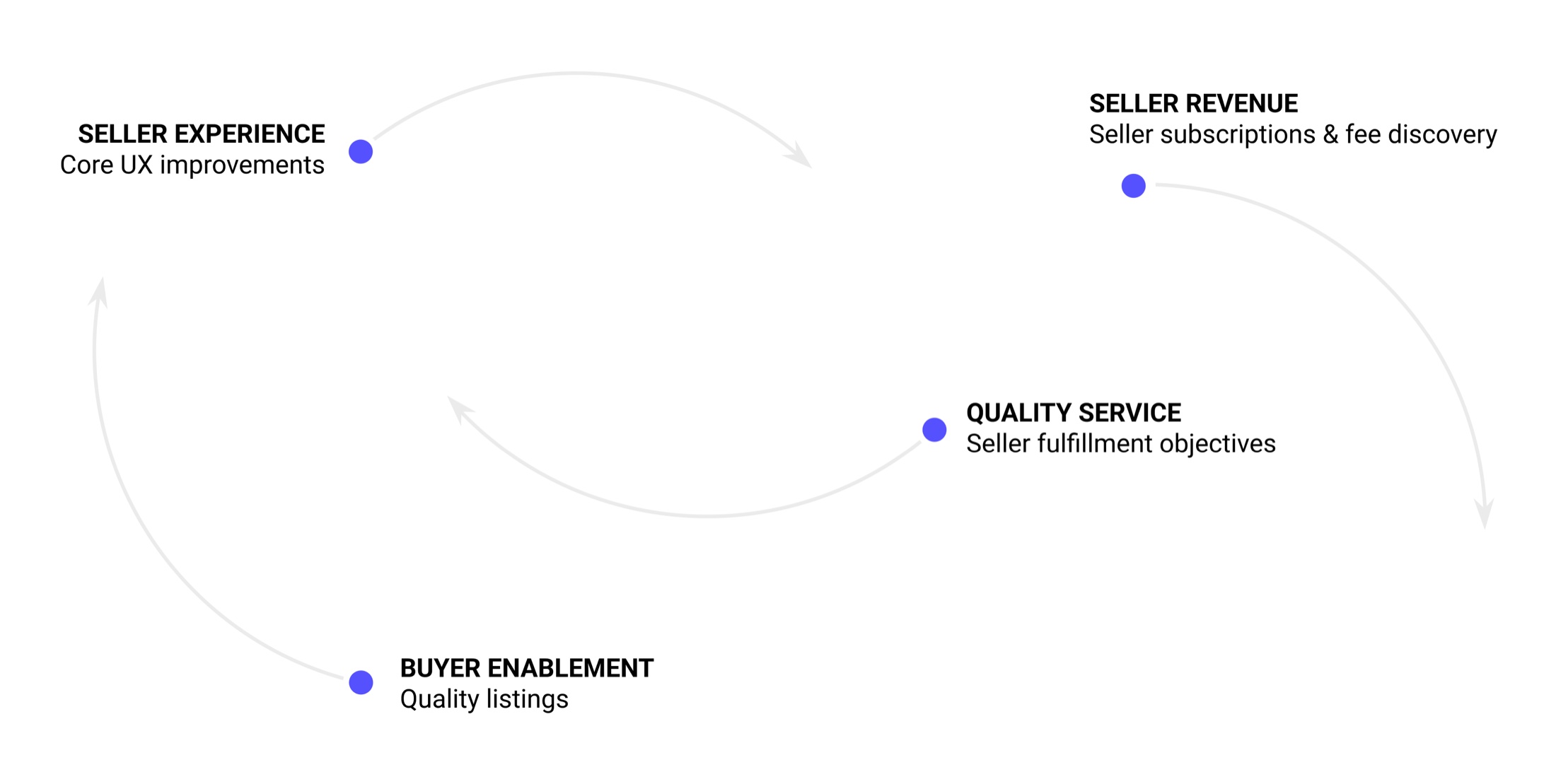
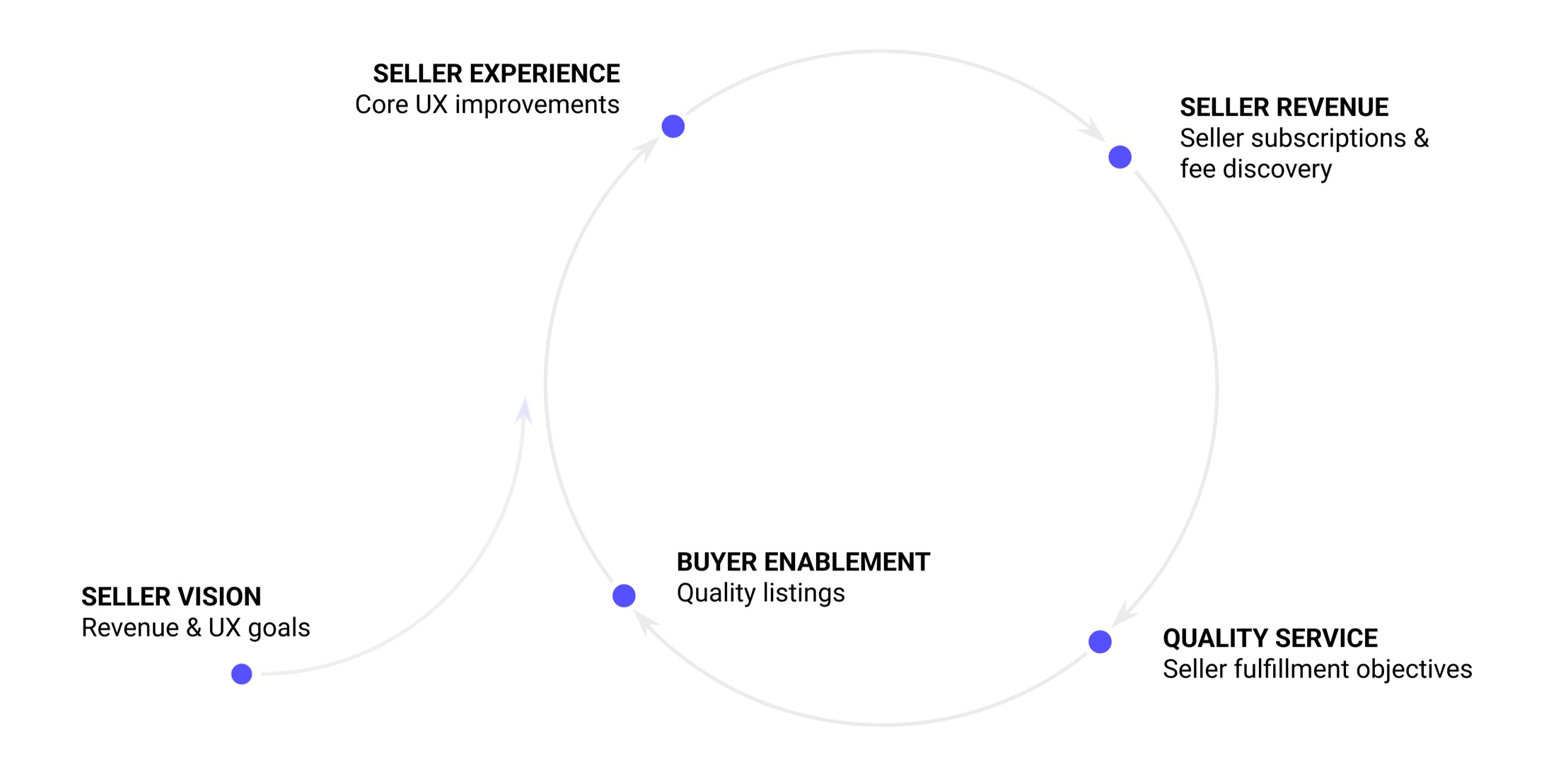
Fig 2: The problem context: fragmented seller strategy and misaligned squad priorities
The Problem
Before any vision work began, we needed to ground ourselves in what sellers were actually experiencing. Four themes surfaced consistently from seller surveys and research, spanning growth, operations, business insight, and IP protection:
"Ultimately, these ongoing challenges were undermining brand trust. It was time to more effectively support our sellers' aspirations for growth, while also addressing the need to increase revenue from sellers."
Discovery
As the strategic design partner in a broad cross-functional working group, my first move was to establish a shared knowledge base before any new thinking began. In collaboration with our UX Research lead, I initiated a synthesis effort to gather and consolidate prior insights on core seller workflows.
The toolkit we assembled drew from five sources:
With the knowledge base established, I led the working group through a series of collaborative Miro sessions using the 1-2-4-All method, a structured facilitation approach that moves from individual reflection to small group exploration to full group alignment. I also partnered closely with our Seller Lead Product Designer, whose deep seller domain expertise kept the vision grounded in design reality throughout.
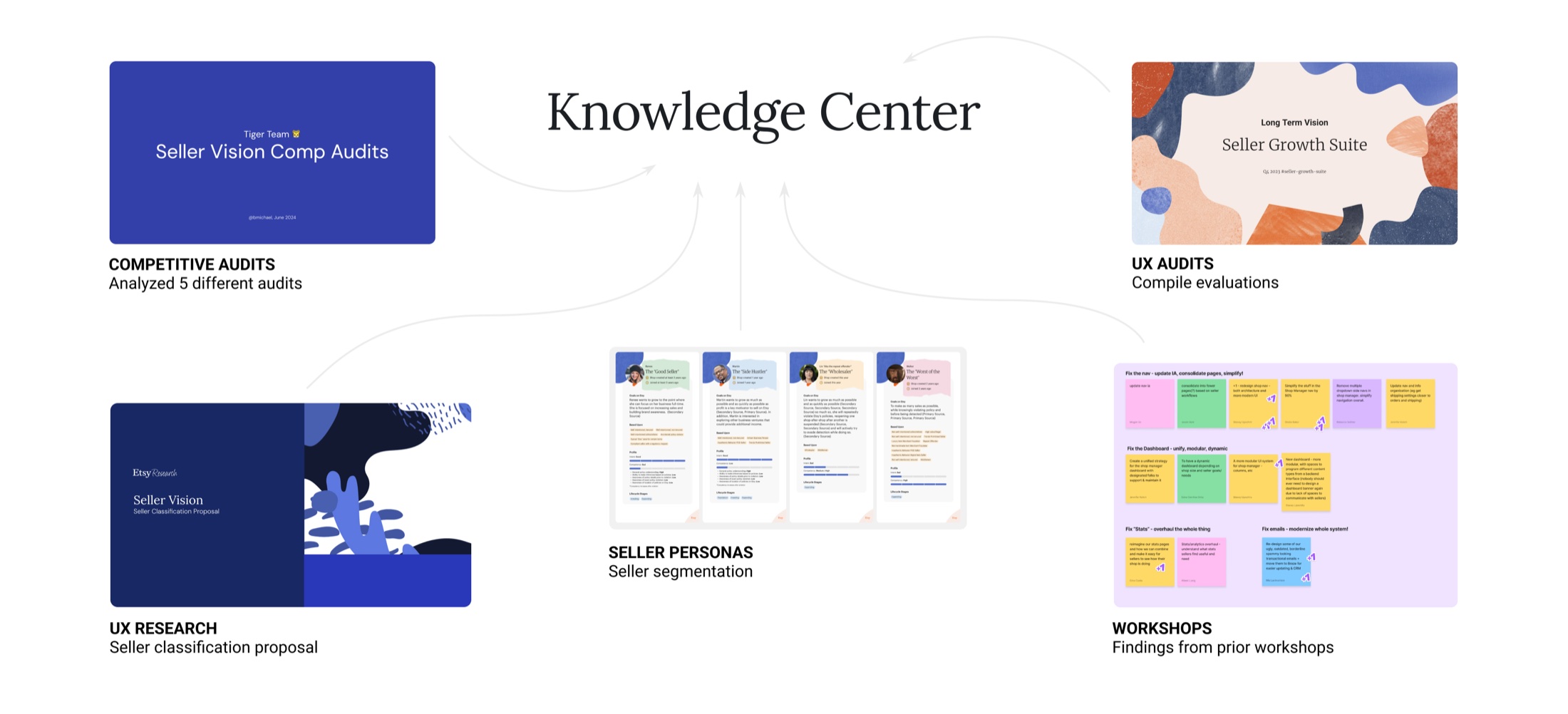
Fig 3: Discovery approach: knowledge base toolkit and research synthesis methods
Vision Workshop
Once the knowledge base was ready, the work could move forward: translating fragmented insights into a unified point of view. The workshop was designed to avoid the trap of presenting a pre-baked vision for people to react to. Instead, we built it together.
The 1-2-4-All format structured the sessions in three phases: individual reflection on vision statement values, paired exploration to combine and remix ideas, and full-group alignment to converge on direction. This approach ensured that the vision felt owned by the group, not handed down from design.
The output wasn't just a statement. It was a framework that connected mission to goal to strategic pillars to measurable KPIs, with seller segmentation (New, Growth, and Professional sellers) running through every layer.
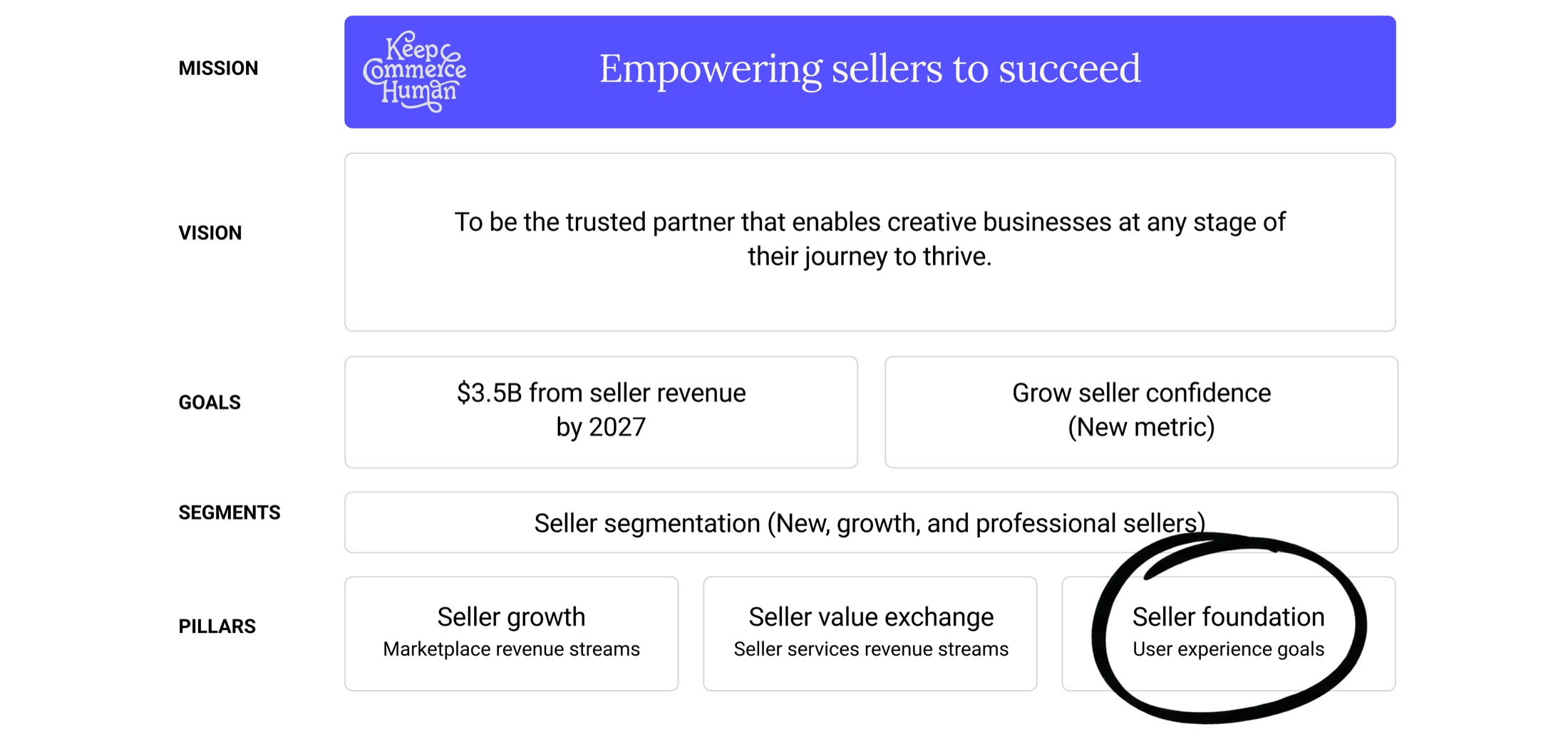
Fig 4: The resulting Seller Vision statement and the creation of Seller Foundations as a new portfolio initiative
The Vision
"To be the trusted partner that enables creative businesses at any stage of their journey to thrive."
The vision statement was designed to be durable: specific enough to guide decision-making, broad enough to apply across the full range of seller-facing work. It connected directly to Etsy's seller mission (Empowering Sellers to Succeed) and organized strategic work into three pillars:
Activation
Getting executive approval on the vision was one milestone. Getting 14 squads to internalize and act on it was the harder, more important one.
After securing final stakeholder sign-off, we ran a structured roadshow across the organization, designed to reach every team and leadership level that would be responsible for executing against the vision.
The goal wasn't to announce a strategy. It was to build genuine buy-in, giving teams enough context to see how their work connected to the broader vision, and enough voice to shape how it would be applied in their areas.
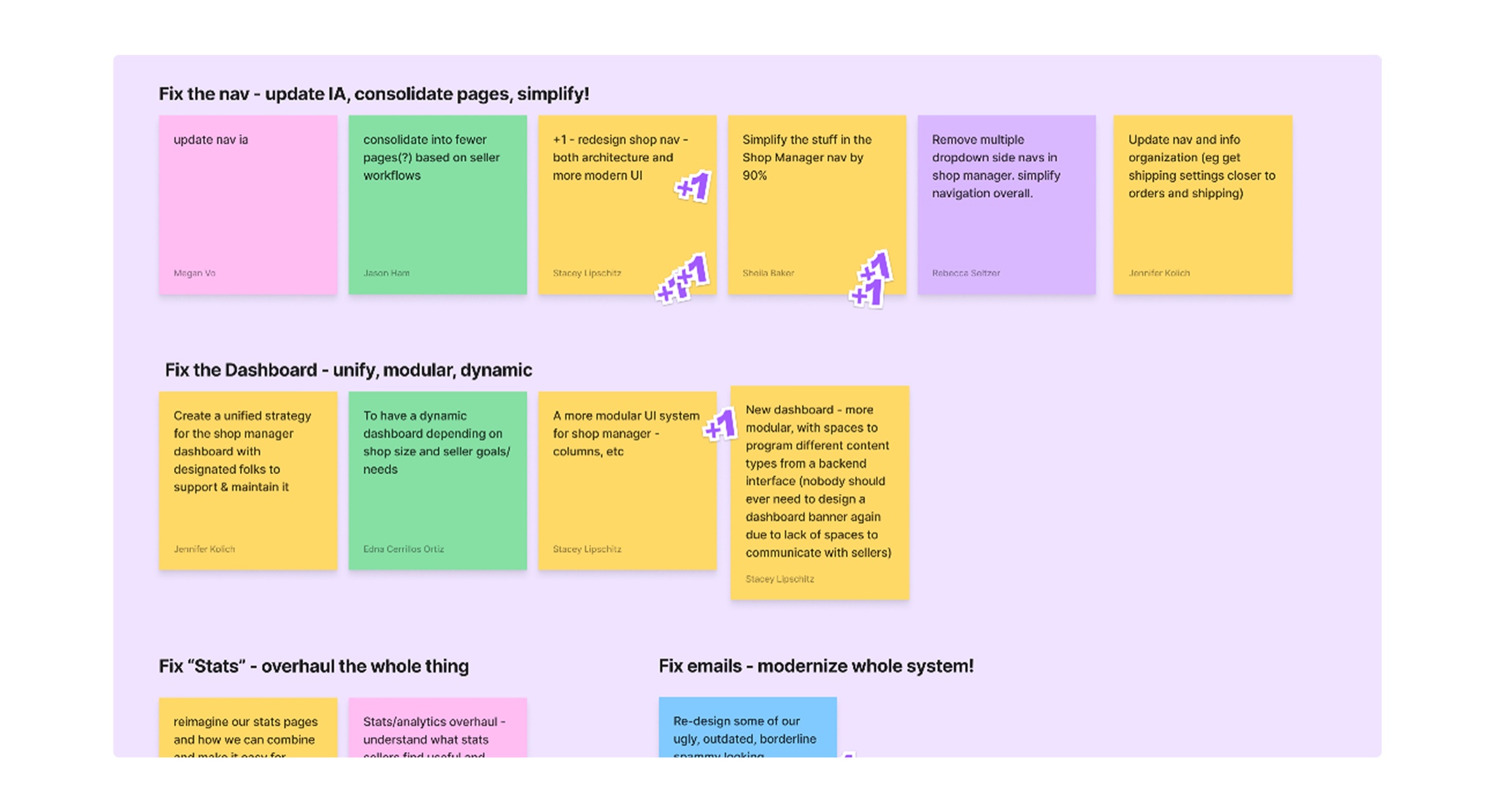
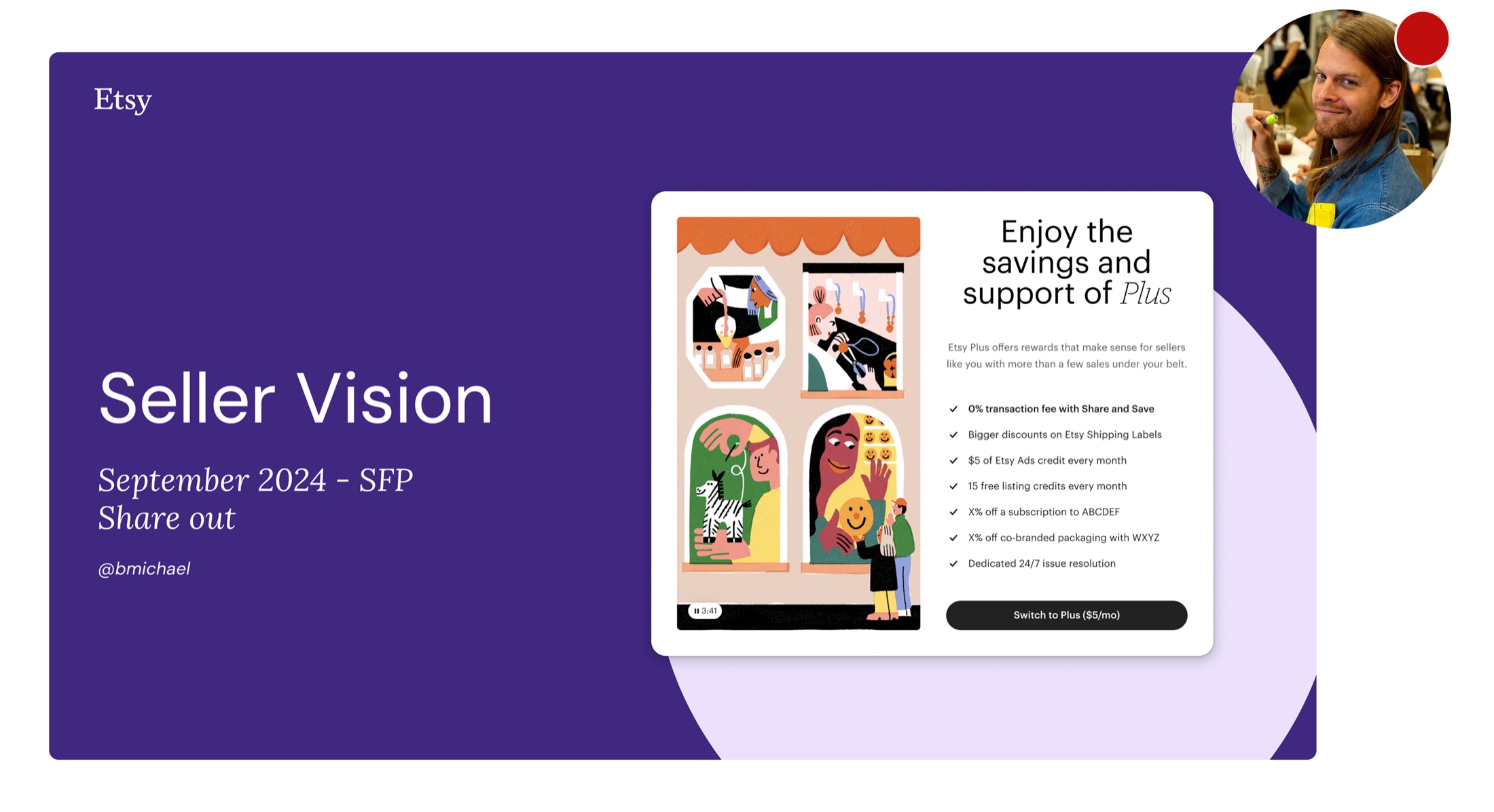
Fig 5: User opportunities derived from vision workshops and roadshow sessions
From Vision to Execution
The real test of a vision framework is whether it actually changes how teams plan and prioritize. For the Seller Foundation Experience pillar, it did.
An internal UX audit conducted across Shop Manager revealed the depth of the design debt we were sitting on. The findings were significant enough to reframe how the team thought about the foundation work:
These findings, combined with the quantitative data, framed the urgency. Platform usability had dropped from ~78% to 60% in two years. Fewer than half of sellers reported being able to fully complete tasks on the native app. The KPI target was clear: Platform Usability > Ease of Use > 75%.
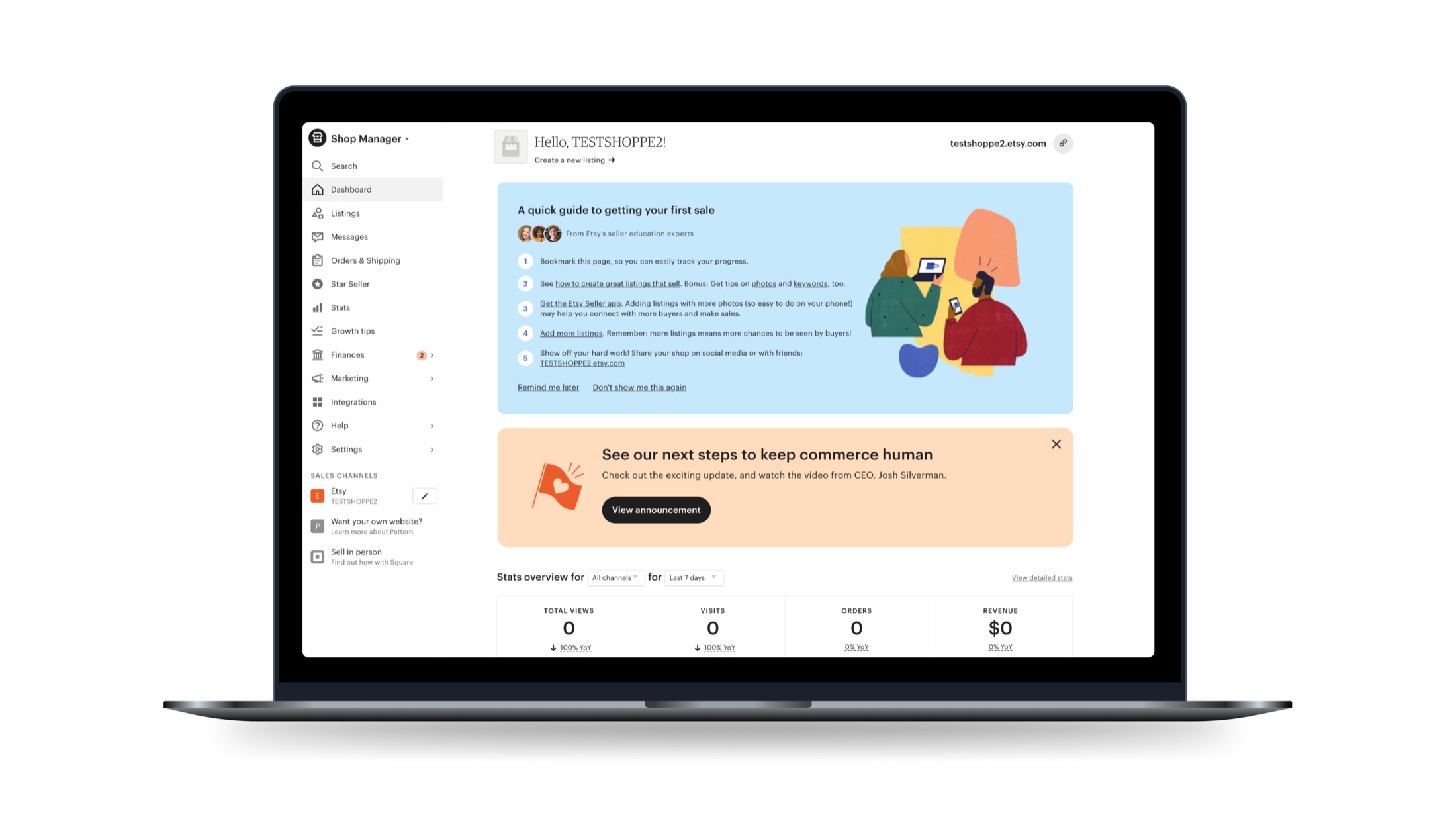
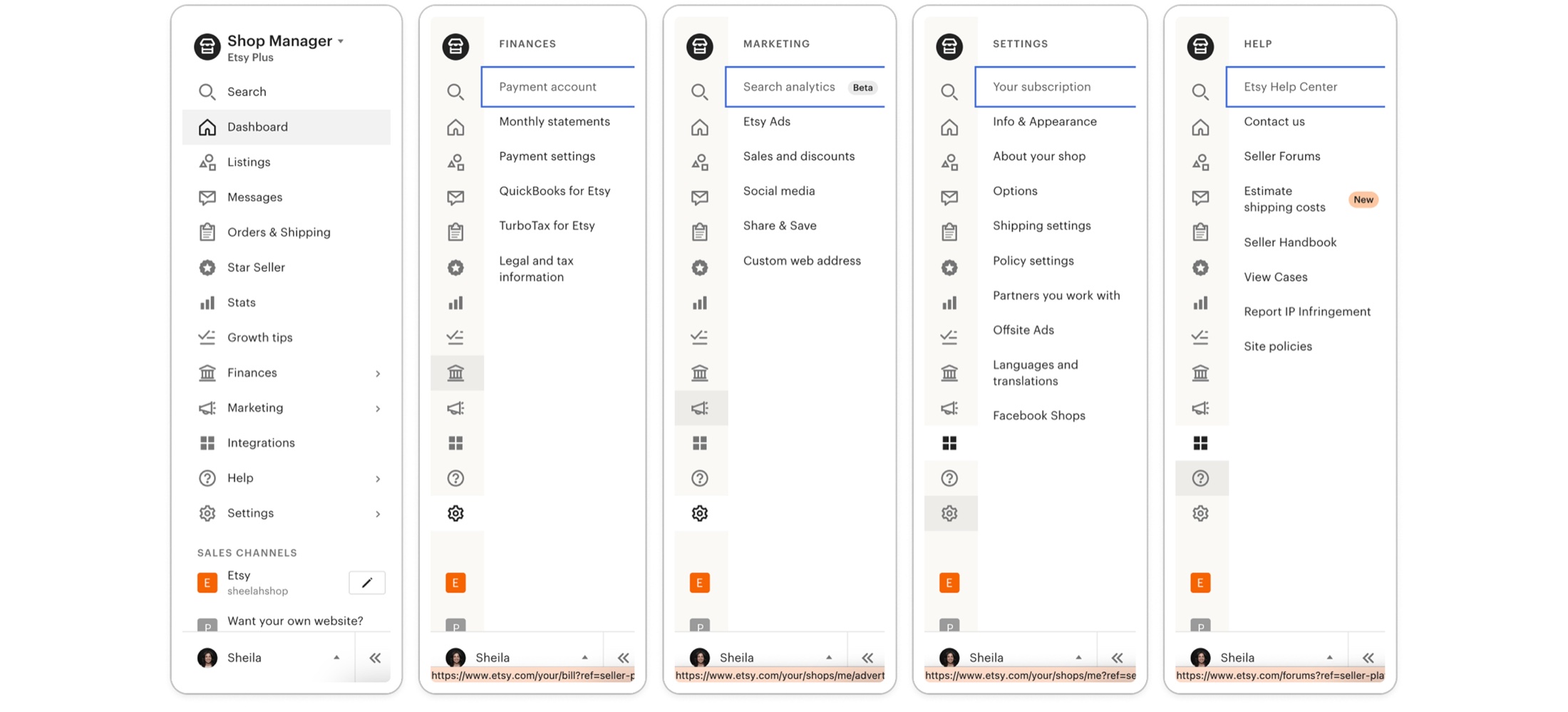
Fig 6: A fragmented navigation structure across seller surfaces resulted in a disjointed user experience
Early Wins
While the full foundation work was scoped and sequenced for 2025, early validation efforts demonstrated that moving in this direction was the right call.
An MVP test of a new Seller Dashboard, designed for growth-stage sellers and anchored to the Seller Value Exchange pillar, delivered a measurable signal early:
+18%
Increase in seller insights engagement
One
Consolidated design backlog across all seller squads
New KPI
Seller Confidence established as a brand new KPI
Sellers were discovering opportunities to improve listing quality and taking action on the recommendations, exactly what the Seller Growth pillar was designed to drive. In parallel, the team reviewed the collective seller experience across native and web, consolidating findings into a design debt backlog accessible to all squads during sprint planning. The vision had created a shared artifact that squads could actually use.
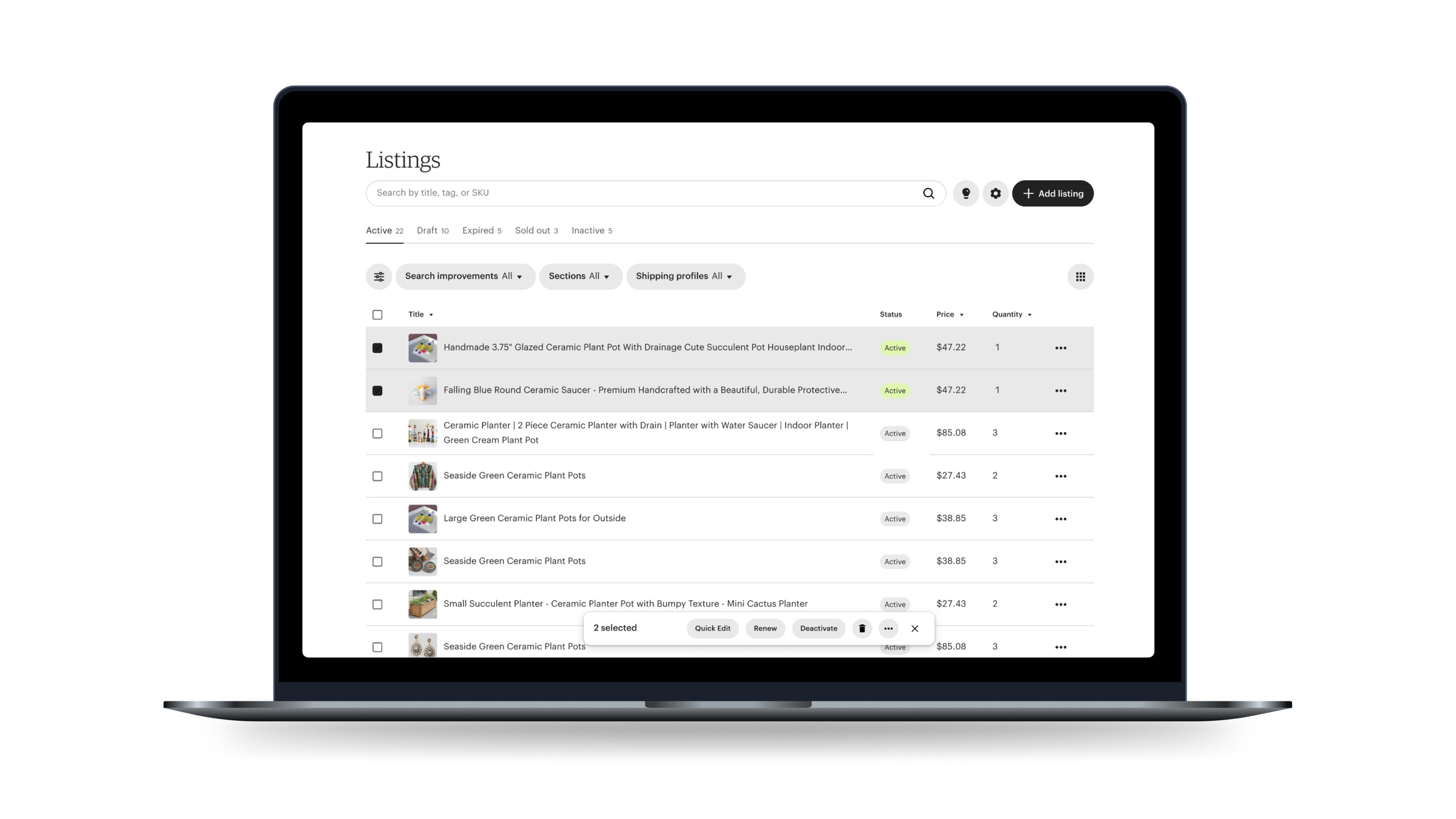
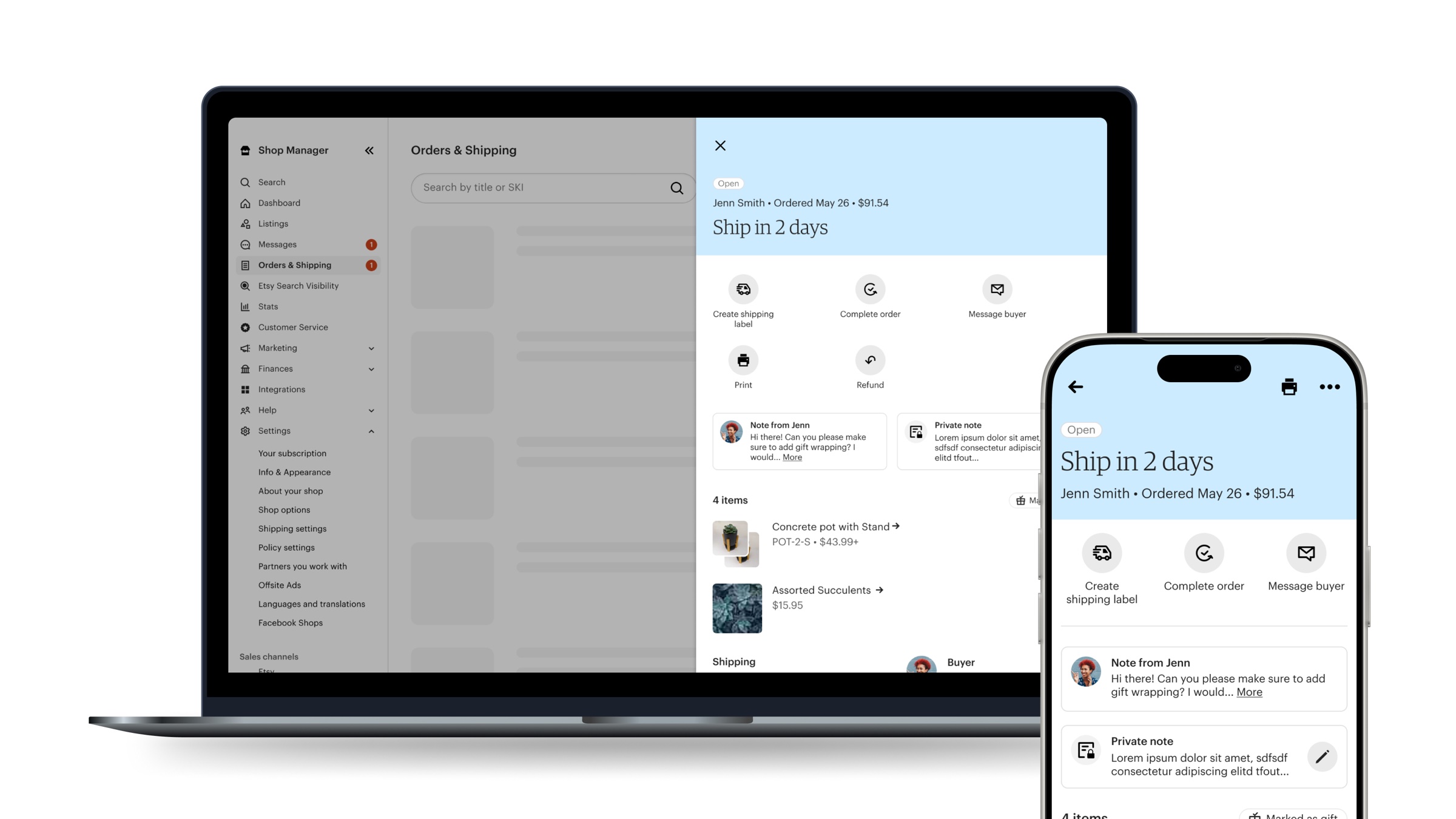
Fig 7: Vision proof-of-concept: Modern Shop Manager listing page and cross-surface seller experience concepts
Reflections
The 1-2-4-All workshop structure was the right call. Bringing people through individual reflection before group discussion meant the vision emerged from the team rather than being imposed on it. That ownership is what made the roadshow land.
Starting with the knowledge base, synthesizing what we already knew before generating anything new, saved weeks and avoided the trap of re-discovering insights that already existed in the organization. I'd do this earlier and more explicitly on future vision work.
Adding Seller Confidence as a new tracked metric was one of the most valuable outcomes. It gave us a leading indicator that the existing KPIs didn't capture. I'd push for new metric development earlier in future vision work, before the framework is finalized.